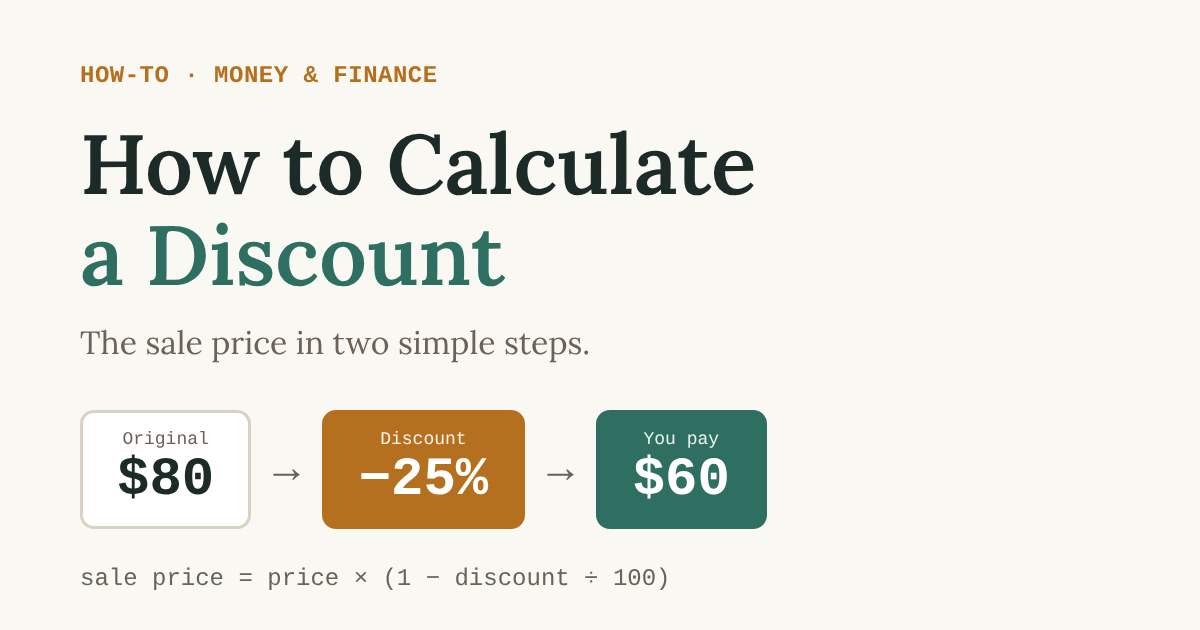
To calculate a discount, multiply the original price by the discount percentage and divide by 100; that is the amount you save. Subtract it from the original price to get what you pay. For a quicker route, multiply the price by (1 − discount ÷ 100): a 25% discount means paying 75% of the price, so you multiply by 0.75. You can check any result with the Discount Calculator.
The rest of this guide walks through that formula with real numbers, then covers the things that trip people up: working backwards from a sale price, finding the percentage from two prices, and what happens when tax or a coupon is involved. The examples use dollars, but the maths is identical in any currency.
The basic discount formula
There are two quantities to know. The discount amount is how much comes off, and the sale price is what you pay.
Discount amount = original price × discount % ÷ 100
Sale price = original price − discount amount
Take a jacket priced at $80 with 25% off. The discount amount is 80 × 25 ÷ 100 = $20, so the sale price is 80 − 20 = $60.
The shortcut gives the same answer in one step. Paying 100% − 25% = 75% of the price means 80 × 0.75 = $60. This version is handy on a calculator because there is nothing to subtract afterwards.
Quick mental maths for common discounts
You do not need a calculator for the discounts you see most often. Start from 10% and build from there, using the same $80 jacket:
- 10% off: move the decimal point one place. 10% of 80 is $8, so you pay $72.
- 20% off: double the 10% figure. 8 × 2 = $16 off, so you pay $64.
- 25% off: a quarter of the price. 80 ÷ 4 = $20 off, so you pay $60.
- 50% off: half the price, so you pay $40.
- 15% off: 10% plus half of 10%. 8 + 4 = $12 off, so you pay $68.
How to find the discount percentage from two prices
Sometimes a shop shows only the old price and the new price. To find the discount percentage, subtract the new price from the old one, then divide by the old price and multiply by 100.
If a pair of shoes was $120 and is now $90, the difference is $30. Then 30 ÷ 120 = 0.25, which is a 25% discount. Always divide by the original price, not the sale price; dividing by $90 would wrongly give 33%. If you only need what percent one number is of another, the Percentage Calculator does it directly.
How to find the original price after a discount
This is the calculation most guides skip, and the one where people make the most mistakes. Suppose you paid $60 after a 25% discount and want to know the original price.
The tempting answer is to add 25% back: 60 × 1.25 = $75. That is wrong, because the 25% was taken off the original price, not off $60. Instead, remember that $60 is 75% of the original, so divide by 0.75:
Original price = sale price ÷ (1 − discount % ÷ 100)
60 ÷ 0.75 = $80
You can check it by running it forwards: 80 × 0.75 = 60.
What happens when sales tax is added
Most stores add sales tax after the discount has been applied. With a sale price of $60 and 8% tax, multiply by 1.08: 60 × 1.08 = $64.80. In the Discount Calculator you can enter the tax percentage in the optional field and see both the price before tax and the final total.
For percentage discounts the order does not change the answer, because multiplication gives the same result either way: 80 × 1.08 × 0.75 is also $64.80. A fixed coupon is different. With a $10 coupon on the same $80 item, taking the coupon off first gives (80 − 10) × 1.08 = $75.60, while adding tax first and then taking $10 off gives $76.40. Which one applies depends on the store, so check the receipt if the difference matters to you. If you are also adding a tip at a restaurant, the Tip Calculator handles that part.
Common mistakes to avoid
- Confusing 25% off with $25 off. On an $80 item they are different: 25% off is $20, while $25 off is more.
- Adding the percentage back to find the original price. Divide by (1 − discount) instead, as shown above.
- Dividing by the wrong price when working out the percentage. Use the original price.
- Adding two discounts together. A 20% discount followed by another 10% is not a 30% discount, because the second percentage applies to the already reduced price.
Frequently asked questions
What is the quickest way to work out 20% off?
Find 10% by moving the decimal point one place, then double it. For $85, 10% is $8.50, so 20% is $17 and the sale price is $68.
Is tax calculated before or after the discount?
In most stores it is calculated on the discounted price. For percentage discounts the final total is the same either way; for fixed-amount coupons it can differ, so check how the store applies it.
What does a 100% discount mean?
The item is free. A discount cannot go above 100%, because that would mean the shop pays you to take the item.
Which is better, 40% off or $30 off?
It depends on the price. On a $90 item, 40% off saves $36, which beats $30 off. On a $60 item, 40% off saves only $24, so $30 off wins. Work out the amount saved for both and compare.