
Body Mass Index, or BMI, is probably the most widely quoted health number in the world, and also one of the most argued about. It takes two inputs, your height and your weight, and turns them into a single figure. That simplicity is exactly why it is so popular, and exactly why it can be misleading when people treat it as a verdict on their health.
What BMI actually measures
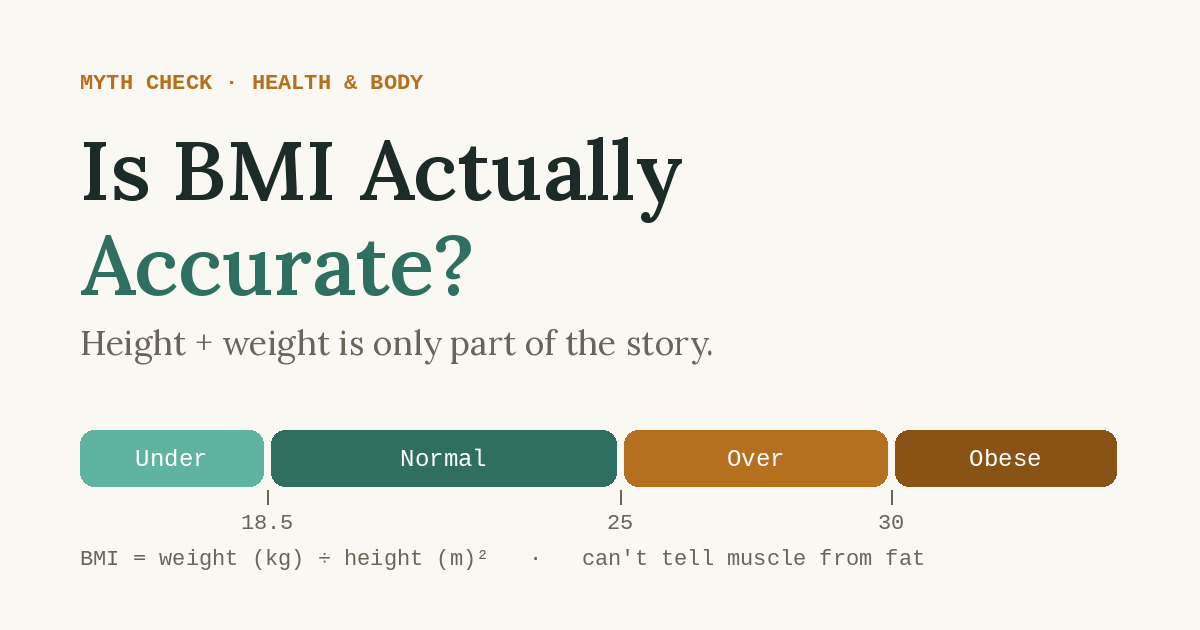
BMI is your weight in kilograms divided by your height in metres, squared. The result is placed into broad ranges used by the World Health Organization: under 18.5 is underweight, 18.5 to 24.9 is the normal range, 25 to 29.9 is overweight, and 30 or above is classed as obese. It was designed in the 1800s as a way to describe populations, not to diagnose individuals, and that origin explains most of its weaknesses.
Where BMI works reasonably well
For large groups of people, BMI does track real health patterns. Researchers use it because it is cheap, fast, and needs no equipment, and across millions of people higher BMI ranges are associated with higher rates of conditions such as type 2 diabetes and heart disease. As a quick first look for an average adult who is not an athlete, it is a reasonable starting point.
Where BMI gets it wrong
The biggest problem is that BMI cannot tell muscle from fat. Muscle is denser than fat, so a muscular person can land in the "overweight" range while carrying very little body fat. The reverse also happens: someone with a normal BMI can have a low amount of muscle and a high percentage of body fat, which is sometimes called being "normal weight but over-fat".
BMI also ignores where fat is stored. Fat around the waist is generally linked to higher health risk than fat on the hips and thighs, but BMI treats them the same. Age, sex, and ethnicity matter too. Older adults tend to carry more fat at the same BMI, and some research suggests the health risks begin at lower BMI values for certain populations than the standard ranges suggest.
Better ways to add context
No single number tells the full story, so it helps to look at BMI alongside other measures. Waist circumference is simple to take and says something BMI cannot about where weight sits on your body. Body fat percentage, which you can estimate with a tape measure, gets closer to what is actually going on under the surface. Beyond measurements, things like blood pressure, energy levels, fitness, and blood tests from a doctor give a far more complete picture than any formula.
How to use BMI sensibly
Think of BMI as a screening tool rather than a diagnosis. If your result falls well outside the normal range, it is a reasonable prompt to look at other measures or talk to a doctor. If it sits slightly outside the range but you are active, strong, and feeling well, the number alone probably should not worry you. Either way, it is one data point, not a judgement.
If you want to see how your result compares with a reference weight range for your height, the Ideal Weight Calculator offers a second perspective. Remember that this is general information, not medical advice, and a healthcare professional is the right person to interpret your numbers.