
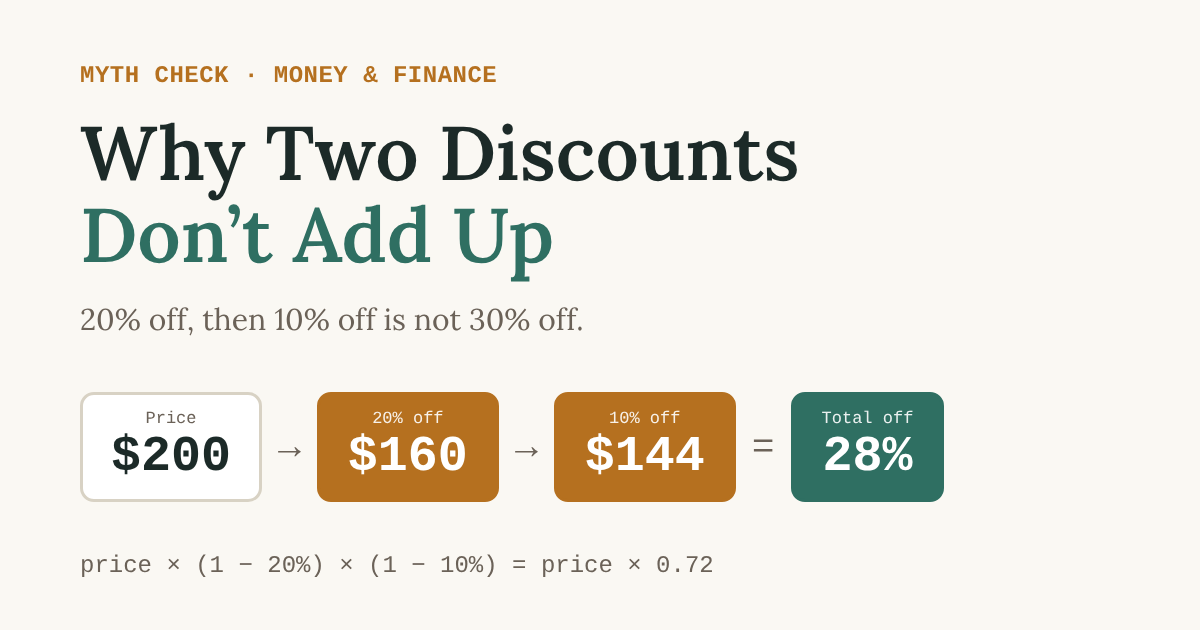
Two discounts never add up to the sum of their percentages. A 20% discount followed by a further 10% discount is 28% off in total, not 30%, because the second discount is taken from the price that is already reduced. The difference looks small on a single item, but it matters when you compare deals or stack coupons.
Below is the reason, the one formula you need, and several worked examples. You can check any of them in the Discount Calculator using its extra discount field. The examples use dollars, but the maths is the same in any currency.
Why 20% + 10% is not 30%
The key idea is that a percentage always refers to a specific price. The first discount applies to the original price. The second one applies to whatever is left after the first.
Take an item priced at $200:
- 20% off $200 is $40, so the price drops to $160.
- An extra 10% off $160 is $16, not $20, so the price drops to $144.
You saved $40 + $16 = $56 in total, which is 28% of $200. A single 30% discount would have saved $60 and left the price at $140. The second discount is smaller in dollars because it is working on a smaller number.
The formula for two discounts
Convert each discount into the share of the price you still pay, and multiply them together with the original price.
Final price = original price × (1 − first discount) × (1 − second discount)
$200 × 0.80 × 0.90 = $144
To turn the pair into one equivalent discount, work out what you pay and subtract from 1:
Total discount = 1 − (1 − first discount) × (1 − second discount)
1 − (0.80 × 0.90) = 1 − 0.72 = 0.28, or 28%
There is also a shortcut in percentages: add the two discounts, then subtract their product divided by 100. For 20% and 10%, that is 20 + 10 − (20 × 10 ÷ 100) = 28. If you want to check what percent one price is of another along the way, the Percentage Calculator does it directly.
Does the order matter?
No. Multiplication gives the same result in either order, so 20% then 10% costs exactly the same as 10% then 20%. Starting with 10%: $200 becomes $180, then 20% off $180 is $36 off, leaving $144. The final price is the same, even though the individual steps look different.
Stacking more than two discounts
The same method extends to any number of discounts: multiply the “share you still pay” for each one. With 20%, 10% and 5% off $200, you pay 200 × 0.80 × 0.90 × 0.95 = $136.80. That is 31.6% off in total, not the 35% you would get by adding them.
Bigger discounts show the gap more clearly. A 40% sale price with an extra 20% coupon is 0.60 × 0.80 = 0.48 of the original, so 52% off, not 60%. Two 50% discounts do not make the item free: 0.50 × 0.50 = 0.25, so you still pay a quarter of the price, which is 75% off.
Which deal is better?
When two offers look similar, convert both to a single percentage or compare the final prices.
- 30% off vs 20% + 10% off. On $200 the first costs $140 and the second $144. The single 30% discount is slightly better.
- 50% off vs 25% + 25% off. On an $80 item, 50% off costs $40. Two 25% discounts cost 80 × 0.75 × 0.75 = $45, because together they are only 43.75% off.
If you are not sure how to find the final price for a single discount, the guide on how to calculate a discount covers the basics, including how to work backwards from a sale price.
Common mistakes to avoid
- Adding the percentages. 20% + 10% is 28% off, not 30%.
- Applying the second discount to the original price. It applies to the reduced price, which is why it saves less.
- Mixing a percentage and a fixed amount. A $10 coupon and a 10% discount are not interchangeable. Apply them in the order the store states, and check which price each one is taken from.
- Forgetting tax. Tax is normally added after the discounts, as shown in the discount guide.
Frequently asked questions
How much is 20% off and then 10% off?
It is 28% off in total. On a $200 item you pay $144, not $140.
Does it matter which discount comes first?
No. Percentage discounts multiply, so the order does not change the final price. A fixed-amount coupon is different, and its order can change the result.
How do I find one discount that equals two?
Multiply what you pay for each: (1 − first) × (1 − second), then subtract the result from 1. For 20% and 10%, that gives 1 − 0.72 = 28%.
Does “extra 10% off” apply to the original price?
Usually it applies to the price after the first discount, which is why the total is less than 30%. Stores sometimes word offers differently, so read the terms if the amount matters.